Wednesday, February 8, 2012

I'M JUST SAYIN'........


Douglas Laycock, Professor of Constitutional Law at the U of Virginia, said it: January 11th's Supreme Court decision holding that ministers cannot sue their churches for employment discrimination was a huge win for religious liberty. It was unanimous, it was sweeping and it was unqualified. This decision was about separation of church and state in its most fundamental sense. Churches do not run the government, select government leaders, or set criteria for choosing government leaders. And government does not run the churches, select religious leaders, or set criteria for choosing religious leaders. The Court unanimously reaffirmed that principle on January 11.

~~~~~~~~~
From “Buzzle.com – Intelligent Life on the Web” comes this helpful hint: "One of the simplest and effective ways to whiten teeth with baking soda is to mix with a small amount of salt. Mix about 3 teaspoons of baking soda with one teaspoon of table salt and then gently apply the mixture on your teeth. This homemade tooth powder can help you to get rid of stains from your teeth.” The article doesn’t say that after brushing your teeth with this powder, rinse your mouth properly with clean water and don’t swallow it!

~~~~~~~~~~

A doctor says: “ Even though families witness their loved one growing increasing ill, few physicians feel comfortable confirming the unthinkable: that Mom will not walk again, Dad will not wake-up again, Jimmy will never fish, laugh or say “I love you” again. In many ways, doctors skirt around the big picture, preferring to emphasize issues that can be controlled. This translates into physicians sharing only small pieces of information, such as “We have corrected her magnesium level” or “the tumor has shrunk by 14%.”

~~~~~~~~~~
In an article entitled “Are Mormon’s Christian? It’s complicated” writer Daniel Burke offers this: According to “The Atlas of Global Christianity,” there are 41,000 Christian denominations. No definition of Christianity could encompass their doctrinal diversity, said Martin Marty, an emeritus professor at the U of Chicago Divinity School. “I wish there was some official place where you could determine who’s in and who’s out, but there’s not. No one can speak for all of Christianity in all its nuances." The atlas lists Mormonism as a “marginal” Christian group, along with Jehovah’s Witnesses and the Rev. Sun Myung Moon’s Unification Church, primarily because it deviates from traditional Christian teachings on Jesus and claims sources of revelation beyond the Bible.
~~~~~~~~~~

A brochure from FEMA (Federal Emergency Management Agency) suggests prior to an emergency, which in our area might be either an earthquake or a wildfire, plan how your family will stay in contact if separated by disaster:

A. Pick two meeting places:
1) a location a safe distance from your home in case of fire, and 2) a place outside your neighborhood in case you can’t return home.
B. Choose an out-of-state friend as a “check-in-contact” for everyone to call.

Even if you haven’t make yourself a Emergency Disaster kit, you can easily do this. It’s important.

~~~~~~~~~~

Jack Wafer Appetizers: Arrange ½-inch squares of
¼-inch-thick jack cheese well apart on a baking sheet generously treated witih nonstick spray. Bake in a 350 degree oven until bubbly, 5 to 7 minutes. Cool just until set, then lift off.


I'm just sayin'............

Sunday, February 5, 2012

'TAINT FUNNY, McGEE!


Our genealogy society usually has a "Show and Tell" program in December and it's always a challenge to think of something that will be of interest to the members and at the same time be helpful in their own research. Last December I was able to come up with both. The picture above was taken as I showed the blanket I was wrapped in when I was brought home from the hospital after being born on June 26, 1935. I also am holding my first pair of baby shoes.

What came next in my "Show and Tell" presentation was from a tiny little book given to my mother. That book was to be her guide for the next few years. In 1935 my family was still suffering from the Great Depression, and my post-natal care was provided by the "Parents Educational Center of Long Beach Social Welfare League." Inside this little book produced by the Welfare League was a monthly handwritten record of who brought me in to see the doctor and what was to be added to my diet.


On the page for September 27 (my 3-month checkup) I was given these feeding instructions: 2 oz evaporated milk mixed with 3 oz of water and 1/2 teaspoon of Karo Syrup. My mother was to continue nursing me. I was to drink water from cooked carrots, peas and spinach - 1 teaspoon to about 2 tablespoons at 2 p.m., Fruit juice and cod liver oil. I continued being taken to these monthly sessions through February and dietary additions are noted. The entries quit after I turned 7 months old.

However, it is not these items that made the most interesting reading. Here’s a photo of a page from the book. I show it in this form because if I didn’t, you might think I had made it up.


First of all, please notice what the expectations are for a child at 1 year and again at 15 months. Now I gave birth to smart kids, but not a one of them could carry glasses of water to and from the table at that age! I don't think I could do it either but I'll betcha' my mom checked to see if I could. She DID think I was pretty smart, if I'm to believe her entries in the actual baby book she kept on me.

On the next page, which covers ages 18 months through 36 months it states that at 18 months the baby should be setting and clearing off the table, wiping dishes, using a handkerchief and replacing it in his pocket and unpinning safety pins in clothes. At 24 months baby should be able to sew buttons on his clothes. Can you believe this?

When I read these pages to the "Show and Tell" audience, they began to laugh (which of course is what I wanted them to do!)

But the best was yet to come: Back in the 3-month category it says, “He should…use the vessel.” That "vessel" meant an old-fashioned chamber pot, baby-sized, of course.

I reminded my "Show and Tell" listeners that my mother kept a baby book on me, and she faithfully recorded everything I did. So I read to them this entry: “When Barbara was three months and 22 days old we began training her to ‘to-to.’” (For you uninitiated in the Dobbins euphemisms, “to-to” was my family’s word for urinating.) Yep, my mother began my toilet training when I was just a little over three months old. She took off my cloth diaper, slipped a little white tin “potty” under my tiny behind and waited to hear the magic tinkle.

She was doing exactly what the book said to do. She does not record when I finally obliged. It suspect she had a long wait but I know for sure is that I didn't show up in kindergarten in diapers!

Those were awfully preposterous guidelines, it seems to me. But I reminded the genealogy group, now composed of men and women considerably younger than I am, that when they see my generation having unusual expectations or being somewhat obstinate in a Board Meeting, consider that we were brought up with very strange goals, very different from the loosey-goosey guidelines of more contemporary child-raising.

Being placed on a cold chamber pot at three months of age has to have left some kind of residual but excusable bumps! So I begged the "Show and Tell" group to please make allowances for us.

I got a good laugh!

Saturday, February 4, 2012

LOOKING BACK


A few months ago I was traveling through Long Beach, the town I grew up in, and decided to detour past 1620 Gardenia Avenue to once again take a peek at the house I grew up in. We moved into that house in August of 1945, just before I started 5th grade, and I called that place “home” until I married in 1955. The husband and I then moved into an adjacent triplex, and later a duplex, that my father built on lots that he purchased on that same street, so being that close to my folks seemed like I still belonged to their house. Every important event, and even the unimportant events, of that time period is imprinted with the image of that house. It was 1959, when our third child was on the way, that needing larger accommodations sent my kids’ dad and me to nearby Orange County where we bought our first house.

My father continued to live in Long Beach until about 1996, and often when I came to visit him he’d suggest we drive by the old neighborhood, so it wasn’t like I hadn’t seen 1620 Gardenia off and on through the years. Early on I was surprised that the front lawn seemed so much smaller than I remembered it, but of course I was just a little kid when we used to play “jump the hedge” off the front porch, sailing over the smallish Eugenia bushes that dad planted along the porch. In fact, even the side yard where we used to put up our badminton set seemed way too small for the game, but when I lived there my dad had not yet built the duplex next door, so we could extend our games out into the vacant lot. In that lot beside the badminton court my dad and uncles drove horseshoe stakes into the ground for their Sunday horseshoe games. The large back yard was reserved for the croquet games that both children and adults played.


A couple of years ago at a high school reunion one of my friends made a remark about how lucky I was to live in such a big house. I was shocked to hear that, because I never considered it a big house…not then, and not now. But in actuality, many of those kids who were my 5th grade friends were from families that had come to California from Oklahoma just before the war and they were basically starting life over again. I remember being in my friend Dokey’s house and it was hardly more than a shack, so I can understand why they thought my house was big. It actually was an 1800 square foot bungalow, only 2 rooms wide but on a deep lot. We had a living room, a dining room, a den, 2 bedrooms, 1 large sewing room with its own outside door used as a bedroom, and 1 narrow added-on room also used as a bedroom and which opened onto the inside back porch. There was 1 bathroom inside the house and 1 fairly rudimentary bathroom (commode and shower only) attached to the outside back porch.


For as long as I lived in that house on Gardenia Avenue, we always had at least one member of our extended family living with us in one of the back bedrooms. For a while it was my mother’s youngest sister after she graduated from high school. Once she left, my father’s maiden cousin lived with us until one of the duplex apartments became available. And from 1946 on, my Uncle Bill lived with us. The house accommodated 6 people nicely.

I loved that old house. I think it was built about 1916 or so. It had a warmth and character that tract housing – the typical cookie-cutter housing that came into prominence after the Second World War – will never have. We had a single telephone, no extensions. In the living room we had a large wooden console containing a radio and a record player; later models came with a small TV. We had a floor furnace that depending on which way you aimed the vent heated either the hallway and bedrooms or the dining room/living room area. In the morning dad, always the first one up, would turn on the heat; my sis and I would get dressed for school standing over the floor furnace.

A gas stove with the oven lit provided warmth for the kitchen. Dishes were washed and dried by hand. Clothes were washed in the machine on the inside back porch and hung out on the clothes line to dry. The inside bathroom only had a tub, so when we came home from the beach in the summer we had to shower in the outside bathroom. Mother didn’t want sand tracked through the house.

Pal, the indoor dog was shut up at night in the large storage closet where the water heater was, and Susie, the outdoor dog who was somewhat handicapped, lived in her dog house in a large pen behind the garage. She had lots of running room, though she ran sideways.

Later dad built an outdoor “rumpus room” in the corner of the backyard, which we girls were to use for entertaining our friends. My parents used it on the weekends for family gatherings. We were lucky to have lots of aunts, uncles and cousins living nearby, and our home was the gathering place for all.


When I drove by that house a few months ago, it seemed that somehow the whole neighborhood had been squashed together. The street seemed narrower, the houses closer together, the yards more compacted and definitely the houses seemed much, much smaller. In thinking about this later, I decided it was because many of the houses had been converted into two dwellings; more people meant cars were parked and packed along both sides of the street, and all the shrubs and trees were old and oversized, dwarfing everything around them. Yes, it was the same house -- a bit modernized, fenced and painted, and it's borne the years well. The neighborhood? Well, a neighborhood is really for those living there now to say how it is.

However, I believe that I couldn’t have grown up at a better time and in a better place than in Long Beach at 1620 Gardenia in the late 1940s and 1950s.

Wednesday, January 25, 2012

THIS 'N' THAT


You will have noticed that I haven’t been carrying on about “The Rock” lately. That's because it is still sitting patiently, waiting for the stars to align so it can begin its 100+ mile journey from here (Glen Avon quarry) to the Los Angeles County Museum of Art on Wilshire Blvd. Now the scuttlebutt we hear is that CalTrans has changed their mind and now says the Country Village overpass above the 60 Freeway cannot support that weight (a 370 ton rock and a 200 foot long transporter equipped with almost 200 tires). Its first scheduled date for making the trek to Los Angeles was August of 2010. Its most recent date is set for sometime the first week in February 2012; whether it will ever make it to LA is anybody’s guess.

+++

In yesterday’s newspaper a small article noted that Pepperdine University in Malibu once again has blocked a request for the formation of a GLBT group on campus, saying that GLBT’s mission is not compatible with the stated Christian values of the private university. A petition signed by some 4,000 students – more than half of the student body – was turned down for the fourth time. Now I attended the first iteration of that college back in the early ‘50s, then called George Pepperdine College. It only had 900 students. The founder was still living and was often a visitor on the campus. Students all understood it was a Christian college and were familiar with the religious emphasis placed on our activities, but even at that time there was tacit approval by many of the teaching staff to get around some of the “shall nots” that the religious denomination required. And there were plenty of gays and lesbians at the college then. It was no secret, but they were our friends and we didn’t give it another thought.

That was then, and these students are now, a braver and more open now. I am watching with interest to see this play out, but recognizing that if the university is truly privately owned and run by a religious denomination, the rules and regulations are set by that denomination and not by law, according to the latest ruling of the Supreme Court.

+++

The large apartment complex where Jer and I live has lots of acreage and an abundance of trees. As novice birders, we wonder how it is that we don’t see more birds than the hummingbirds at our feeder, our resident phoebe, the sparrows and house finch in the spring and of course, Archie Grosbeak who comes yearly to produce his offspring and stay until they’ve fledged. Everybody here sees those birds; where are all the other birds I should be seeing?

Oh, there are crows, too. Mighty hordes of large, noisy crows making a nuisance of themselves by sitting 50 or so to a tree and cawing at each other all day long. I hate crows, because they eat other birds’ babies. (So do cowbirds and I hate them too.) However, a friend of mine suggested that perhaps they weren’t crows but ravens, since I described them as being huge birds. I looked in my bird book specific to this area (Backyard Birds of the Inland Empire) and it showed me the difference between crows and ravens. But discerning that difference depends on several things that are hard to see from a distance: their size, the shape of their tail, and how much they soar when they are in the air (ravens soar more than crows.) However, I think there is only one definitive identification: mine are crows because none say “NEVERMORE,” only “caw.”

Saturday, January 21, 2012

THE BATTLE OF THE BRAIN


I am always surprised (and sometimes shocked) by things my brain can remember.

Jerry and I were in the local library picking up a book I had on reserve. I quickly thumbed through it to make sure it was what I wanted, when my eyes landed on the name of a doctor: Dr. Dupuytren. When I read that name, I stopped dead in my tracks, turned to my husband and pointing to the book page said, “Ah, this guy had something to do with either a finger or a penis.”

That caused Jerry to stop in his tracks. But as if to clarify matters I said, “The other one’s name was Dr. Peyronie.” Jerry looked at me like I was crazy, but then it happens so often that he’s just not surprised by anything anymore. What rumbles around in my head may be useless nonsense, but it had to get there somehow.

The only time I heard of these names was back in the late ‘80s when I was on a temporary secretarial assignment working for a firm that handled medical malpractice claims. I was typing from a Dictaphone tape and I needed to look up these two medical conditions in the course of transcribing the tapes onto the computer. I had not heard of them before, nor did I ever hear of them again.

Both doctors were French; both conditions deal with fibrous tissue that shouldn’t be where it is. And a quick check through Google connected Dr. Peyronie to the penile problem, now known as Peyronie’s disease, and Dr. Dupuytren to the finger problem, also known as Dupuytren’s contracture.

What I’d like to know is how, in late 2011 did my brain, unbidden, offer up this information when I glanced at the reference to Dr. Dupuytren in a novel I intended to read (I think it was a novel about Sherlock Homes)? My brain doesn’t tell me something simple like where I set my car keys, or where I kicked off my shoes, or worse yet, give me the name of an old friend I run into. Why then will it bring up Dupuytren and Peyronie?

I’ve experienced the same kind of thing in other ways too. While living Turkey and taking lessons to learn the language, quite often my brain offered the Spanish version of the Turkish word I was looking for. Yes, I had two years of Spanish in the 1950s, but we spent those two years translating novels, not learning how to converse in the language. Did my brain really retain all those Spanish words I learned?

But again, this all makes me wonder why I can’t remember where I put things in my house. Well, that’s not quite right, Jerry says, because if I would put them where they belong instead of just dropping them somewhere I wouldn’t have to wrack my brain trying to remember. And I also do know that as we age it is the short term memory that goes first, which explains a lot of what I can’t remember. But I’ve read that EVERYTHING we’ve ever known rattles around in our brain forever and is there for recall if the stars are all aligned or for some other reason.

I think I’ve mentioned before the writer Mary Roach who in her fine book “Stiff” told about Thomas Edison, who believed that there were little things he called “life units” in our brain that existed in every cell and operated in shifts. He wrote in his diary “We do not remember. A certain group of our little people do this for us. They live in that part of the brain which has become known as the ‘fold of Broca.’...There may be twelve or fifteen shifts that change about and are on duty at different times like men in a factory….Therefore it seems likely that remembering a thing is all a matter of getting in touch with the shift that was on duty when the recording was done.”

I don’t particularly follow Edison’s beliefs in this matter, but I do know Jerry and I often poke fun at each other’s lapses and admonish the other to wait for the next shift to come on. Since I most always find what I have lost, I trust it more to luck than life-units.

Nevertheless. what I still don’t understand is how come if I can pull up Dupuytren and Peyronie so easily, why can’t I do it with the easy stuff?

Monday, January 16, 2012

WHO? ME? AFRAID? NO, JUST SMART!


I am not a particularly fearful person, although I admit to sometimes considering the worst possible outcome when I’m confronted with certain possibilities. That little quirk has been with me since I was a small child, not even old enough to understand “outcomes.” The earliest I remember is being afraid of fire….or more specifically, fire engine sirens. When I heard a siren, I’d go hide in the closet, or if I was outside, I’d go stand with my back to a wall. I’d somehow feel protected that way. I don’t know when it started but by first grade this fear had pretty much abated.


The second fear I acquired was of water, but not just of any water. It was of falling into water. I was brought up in Long Beach, California, where my folks often took us for a drive around Rainbow Pier, a horseshoe shaped pier that jutted out in the ocean as shown in the postcard above. There was water on each side of the pier – a lagoon on one side and the ocean on the other. The pier was plenty wide for the one-way auto traffic and there was never the possibility of a car plunging into the water, but I think that was the time and place when I first thought about “certain possibilities” – that of ending up inside our car in the drink! Eventually I outgrew that particular fear, but the residual to that is that as an adult I don’t do causeways, anywhere, anyhow! I will walk around Lake Ponchartrain before I would drive a causeway across it.


The whole reason I am writing about this is that this past weekend a car full of Taiwan tourists on the little three-car Balboa Island ferry that takes people across the narrowish Newport Harbor found themselves in that very predicament, having had their rented SUV pushed off the end of the Ferryboat by an errant Mercedes that was being parked on the boat behind them. The TV showed the SUV bobbing around in the bay – and my insides reacted as if I, not the Taiwan family, were the one who was in that SUV.


Taking a ride on the Balboa ferry was, in my growing up years, second only to taking a drive around rainbow pier. In the evenings we did the pier; on the weekends, because it wa a little further down the coast from Long Beach, my folks did the Balboa Ferry. To my recollection, I never once stayed in the car while it was on the ferry. We always got out of the car and sat on benches along the gunwales. If the car was going in the water, I was for sure not going with it. So when I saw the TV news of that very thing happening, it was as if prophecy was fulfilled. I could honestly say, “I KNEW IT!” and my latent fear was finally justified


I did not bring these fears (very much) with me into my adult years. I rode on the “feribot” (Turkish spelling) a lot in Istanbul, but usually it was just the people ferry, not one that carried cars. However, to hedge my bets, I always found a seat right near the big opening on the sides, which you will be able to recognize from the picture. Especially while traveling across the Bosphorus, where the feribots were going across the water and the big supertankers were going up and down the water, sharing the same space, I was always a bit leery of – again – the worst possible outcome. That would be a collision between my boat and the tanker, especially since while we were there one of those tankers collided with a freighter carrying 25,000 sheep; the little tanker split in two and 25,000 sheep were accidentally drowned right in the middle of Istanbul’s Bosphorus. So although I rode on the feribots, I was not a comfortable passenger and even in the winter with the bitter wind blowing in those side openings, you could see me easily hedging my bets, wrapped like a mummy in warm clothing!

So here I am at 76, having survived all kinds of remote possibilities. I was a worrier as a kid, my mom told me, and I understand. I still tend to verbalize these remote and unlikely possibilities, according to Jerry. But I say, having taken to heart the old adage “Forewarned is forearmed,” that one might as well be ready to choose your own poison, and should I find myself in that spot, it fer shure won’t be from a ferry boat accident.

Sunday, January 8, 2012

THE BENEFIT OF RESOLUTIONS


While I was recuperating from my Christmas Eve surgery, I had a lot of time to think about New Year's Resolutions. Actually, I don't make what I'd call "resolutions" but I always try to identify anywhere between one and five projects that I can take on for the new year. So my thinking this year went something like this:

1) I need some housecleaning help.
2) I need to thin out all the junk that sits on the floor in this tiny apartment before this can happen.
3) Make a plan to do this, and then do it!

At first I thought I'll move out one item per day. Then I decided no, I'd do one item a week. Then I decided to get real; I decided that one room per month would be the smartest way to get the job done.

January's room is my office. I also allotted two months for this; my office is the repository for my computer, my books, and my knitting, in addition to storage for our gardening supplies, bird feeders and food, old camera equipment, luggage and sewing machine. I would show you a picture of this room, but it is too embarassing to contemplate. Trust me when I say many things need to go. The issue of cleaning comes down to the fact that there is no place to move anything when trying to clean the room. I cannot yet ask someone to come in and clean this room in this condition. But perhaps by the end of February I can.

So, given this explanation, what do all these pictures in the blog mean?

In my closet, pushed way deep in an inaccessible area, was a tall trash basket in which I stored rolls of gift and mailing wrapping paper, large genealogical maps rolled up in tubes, and other items that were there for lack of a better place for them. We moved into his apartment 6 years ago and I rarely had occasion to get anything out of this basket.

Ditching the basket and contents became my first project. In nosing around I found all kinds of things in there that I had completely forgotten about. Some I could toss, some could be put in my genealogy files now, and some given to a thrift store. Within 1/2 hour the basket and at least 3/4 of the material in it was on the way to the dumpster across the street.

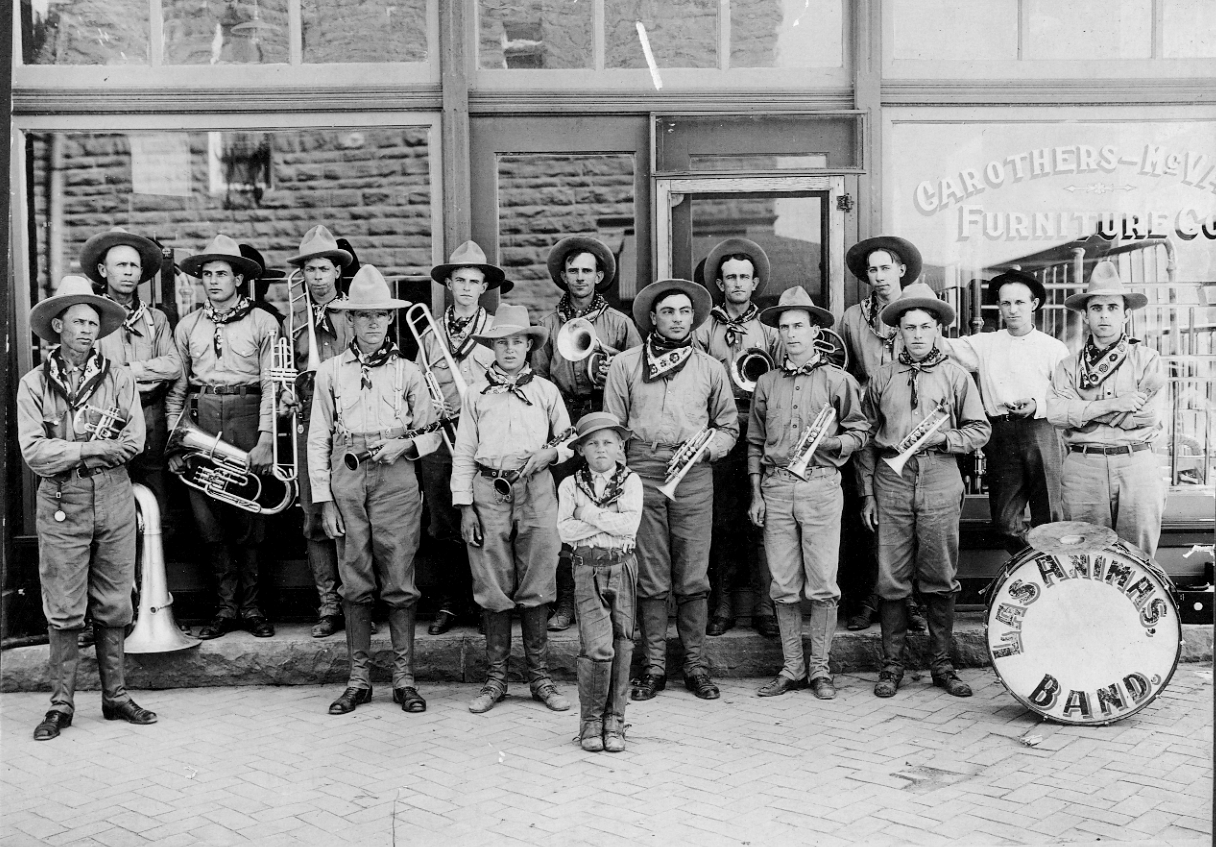
But the big surprise was finding in it a cardboard envelope containing some photos that I hadn't seen in years. These were the photos of the bands and the bandsman shown in this post.

In the photo shown at the top of the blog you'll see my paternal grandfather, Scott W. Dobbins Sr. He came from a musical family, and from his early teens he played cornet.

The first picture below is of the West Las Animas (Colorado) band, sitting on the Bent County courthouse steps. Scott, with the cornet at top right, was probably 16 years old then, which would put the date somewhere around 1890.


During the summers both he and his older brother Gaston, a trombone player, played with the Colorado Springs Midland Railway band and participated in many huge band festivals and competitions held in that part of the country. The band had at least two uniforms that I am aware of: one was the traditional "railway" band such as my grandfather is dressed in above and the other was called the "Buckskin" uniform, in which they dressed in Indian regalia. It is this picture that was the big surprise for me. I remember seeing the picture in a newspaper article but I have no recollection at all of getting a decent photograph of it. But there it was, carefully protected in the bottom of the basket I was cleaning out.


The final picture is a 1902 photo of the little Las Animas band again. Scott and his brother Gaston are in it, and the little guy in front is my dad's cousin Percy (Gaston's son) who was the mascot.


Finding the picture of the Buckskin band was an added plus to my first foray into thinning out my "junk." My grandfather Scott died in 1917, long before I was born, and it is a good feeling to have him so well documented visually. Morever, this makes me wonder what else I'm going to turn up as I continue on this year's resolution.